

Fewer problems.
More of the week back.
Monitoring, maintenance, vendors and a roadmap, run to a schedule rather than a ticket queue — so most problems close before your team notices, and the week goes to the work that earns.
Monitored isn't managed
Break-fix support, and plenty of plans sold as managed, are paid when something goes wrong. That is the whole problem: nothing in the arrangement rewards preventing the next outage, so prevention is whatever is left once the queue is clear.
And the cost never arrives as a line item. There is no invoice for the slow morning, the third day a new hire waits on a laptop, or the hour spent deciding whose problem it is — so it stays invisible, and nothing changes.
-
Paid to prevent, not to repair
A standing agreement to keep the environment healthy means every problem we stop is our own cost avoided too. The incentive points at fewer problems, not more invoices.
-
You hear when something is done
You are told when a ticket is raised and when it is closed, so work does not happen silently and nobody has to chase us to find out where something got to.
-
Nothing ages out of support quietly
Because your environment is documented rather than remembered, we know what is there and how long it has left — so replacing something is a decision you make early, not a bill that arrives with an outage.
Which of these sounds like last month?
None of these is bad enough to fire a provider over. That is exactly why they keep happening.
Tap any that sound familiar to see how we handle it.
Everything we handle, so your team doesn't have to
-
Monitoring & maintenance
Most problems close before you hear about them
Servers, endpoints and network watched continuously and patched on a schedule.
-
Help desk
Nobody has to re-explain your setup
Remote and on-site support from people who have worked on your network before.
-
Vendor management
One number, whoever's actually at fault
Your internet provider, software vendors and hardware warranties — we make the calls.
-
Backup & continuity
A recovery you've already watched work
Backups verified by actual restores, with recovery times agreed before you need them.
-
Security baseline
An answer on paper when a client asks
Patch discipline, secure configuration and endpoint protection — the foundation clients and insurers ask about.
-
Roadmap & projects
Growth without IT becoming the bottleneck
A living plan for upgrades, new sites and end-of-life hardware, delivered by the team that already runs your environment.
Switching providers, in the order we do it
It sounds disruptive, and the order is what stops it being. Nothing gets changed until we know what is there.
-
Stage one
Document
We map what you have — devices, accounts, vendors, licenses — and where the risks sit. You end up with the whole environment written down in one place.
-
Stage two
Stabilise
The obvious risks close first: patching brought current, backups checked, monitoring switched on. This is when the week starts getting quieter.
-
Stage three
Plan
With the ground steady, the picture is clear enough to be useful: what is aging, what is out of support, what will need replacing before it fails. You hear about it from us, early, instead of finding out on the morning it stops.
Answered by someone who knows your network
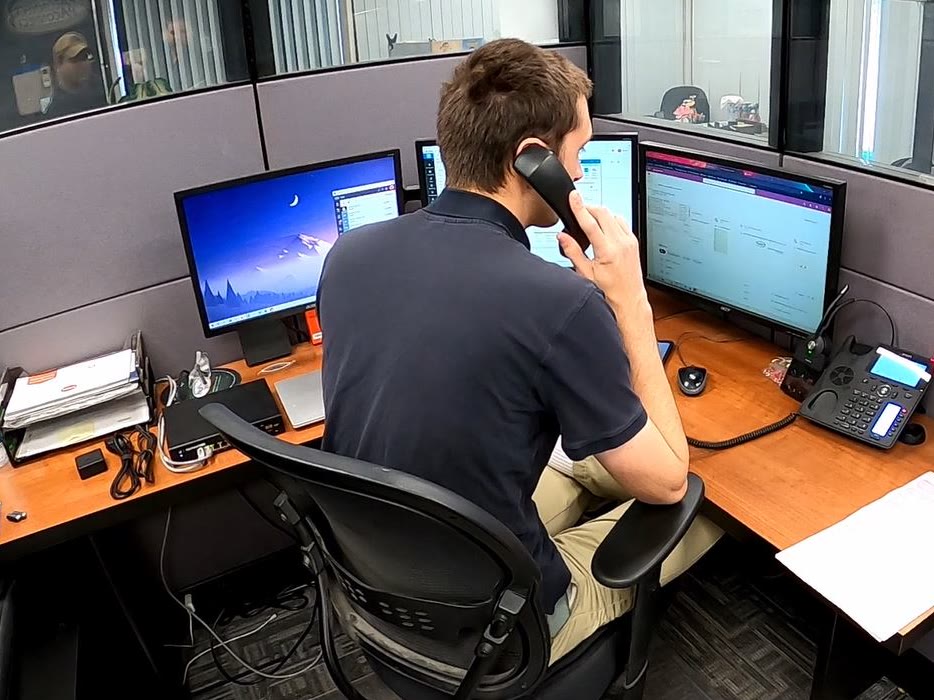
When something does break, the first ten minutes decide the rest. The person who picks up has seen your environment before and knows what changed last month. Nobody reads you a script. And if it turns out to need an engineer, you get one — not a queue position.
Most of it is not dramatic. A password that will not reset, mail that stopped arriving, a laptop that will not wake up on a Monday morning. Your staff call or email the same team that documented your network, and it gets dealt with rather than logged.
Cover runs through the working day as standard. Businesses that need someone at three in the morning can buy that too — extended evening cover, or round the clock — and we would rather sell you the hours you actually need than a number that sounds good on a website.
One of the management team came to my office the next morning to rescue our server. If you need IT support that is going to take your business as seriously as their own, these are the people to call.
What owners ask before they switch
What's included in managed IT?
Continuous monitoring and patching, remote and on-site help desk, vendor management, verified backups, a security baseline and a technology roadmap — all run by one team that knows your environment.
How is this different from calling someone when something breaks?
A standing agreement, service levels, and a documented environment rather than a series of call-outs. The practical difference is who notices first: in many instances we open the ticket before anyone on your team reaches for the phone.
Does it include cybersecurity?
It includes the baseline: patching, secure configuration, endpoint protection and monitoring. Managed detection and response, security awareness training and compliance work sit in our Cyber Security service, which is built to run alongside it.
Do we have to replace our current vendors?
No. We manage them. Your internet provider, software vendors and warranties stay in place; we become the single point of contact for all of them.
What about after hours?
Office hours are Monday to Friday, 9:00 to 5:00. Outside them, what happens depends on the cover you have — extended evening support and round-the-clock cover are both available — and every client's service agreement carries the number to call.

Start with where the business is going
A strategic discovery session is a conversation about your plans and what your technology needs to do to support them. No audit, and no proposal unless you ask for one.
Want the longer argument first? Why businesses switch to PAconnect →
724-838-7526Thank you — we'll be in touch.
A member of our team will reach out within one business day to schedule your discovery session. If it's urgent, call 724-838-7526 and ask for the help desk.