Somewhere in your business, a client email is being pasted into a chatbot right now. That isn't a discipline problem — it's what happens when a technology arrives faster than the policy, the training and the plan around it. We close that gap: what your tools can already see, what your people are allowed to do, and how they actually get good at it.
Everything your team needs to use AI safely: the policies, the training, and the guides behind them.
13Guides, policies and playbooks
230Slides of ready-to-run staff training
Why change
AI didn't arrive through your IT department.
It arrived through a browser tab. One person tried it on a proposal, it worked, and they told two colleagues. No rollout, no training, no policy, and no record of what went into it.
Most businesses discover their AI program already exists — informally, unevenly, and entirely undocumented. That isn't a problem to solve later. It's an operating decision you are currently making by default.
The same story, narrated, with sound and captions.
Select what sounds familiar
Tap any that sound familiar to see how we handle it.
How we handle it
Know what's exposed. Put the rules in writing. Make your people good at it.
Three steps, in that order. The first two protect you. The third is the one almost nobody else is selling — and it's where the return actually comes from.
AI Readiness & Exposure Review
Visibility before rollout
Before any AI tool is switched on, we establish what it would actually be able to reach — your file permissions, your shared drives, the systems it would connect to, and the data sitting in places nobody has audited in years. You get a plain-language picture of what's already exposed.
Permissions and data-hygiene review, an inventory of the AI tools already in use across your team, and a prioritized list of what to fix first. Included in your managed services agreement — not a separate engagement to negotiate.
Policy, Guardrails & Incident Response
Decisions on the record
A written acceptable-use policy your staff will actually read, covering what can and can't be put into an AI tool, how it applies to client and patient records, and what happens when something goes wrong. Mapped into the compliance framework you already report against.
Usage policy, a guide to the connectors and plugins that quietly extend an AI tool's reach into your systems, an incident response playbook, and HR and marketing guidance for the departments most likely to use AI on sensitive material. Versioned, dated and reviewed annually — mapped to NIST, HIPAA, PCI and FFIEC.
Staff Enablement Program
Capability, not just compliance
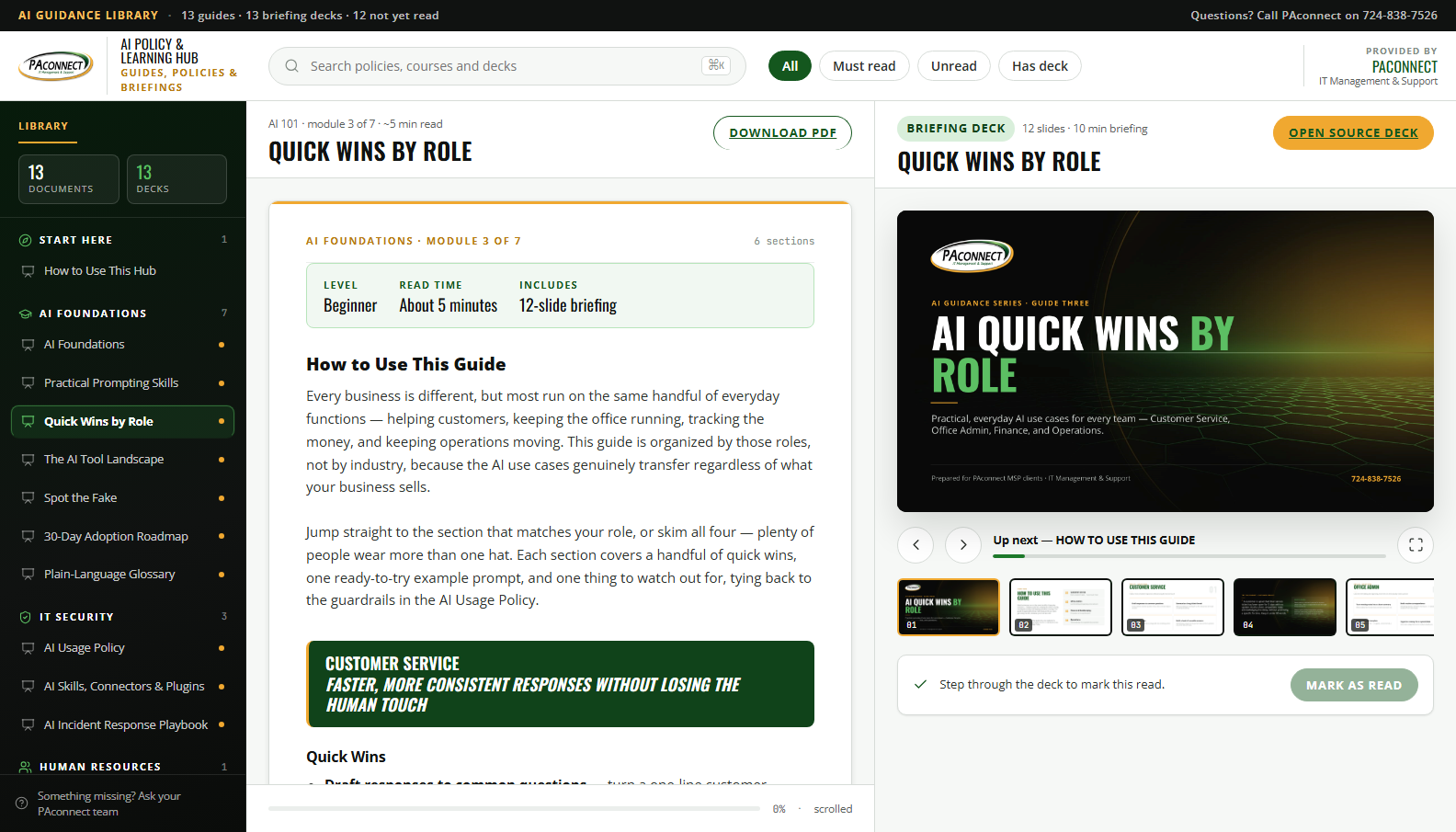
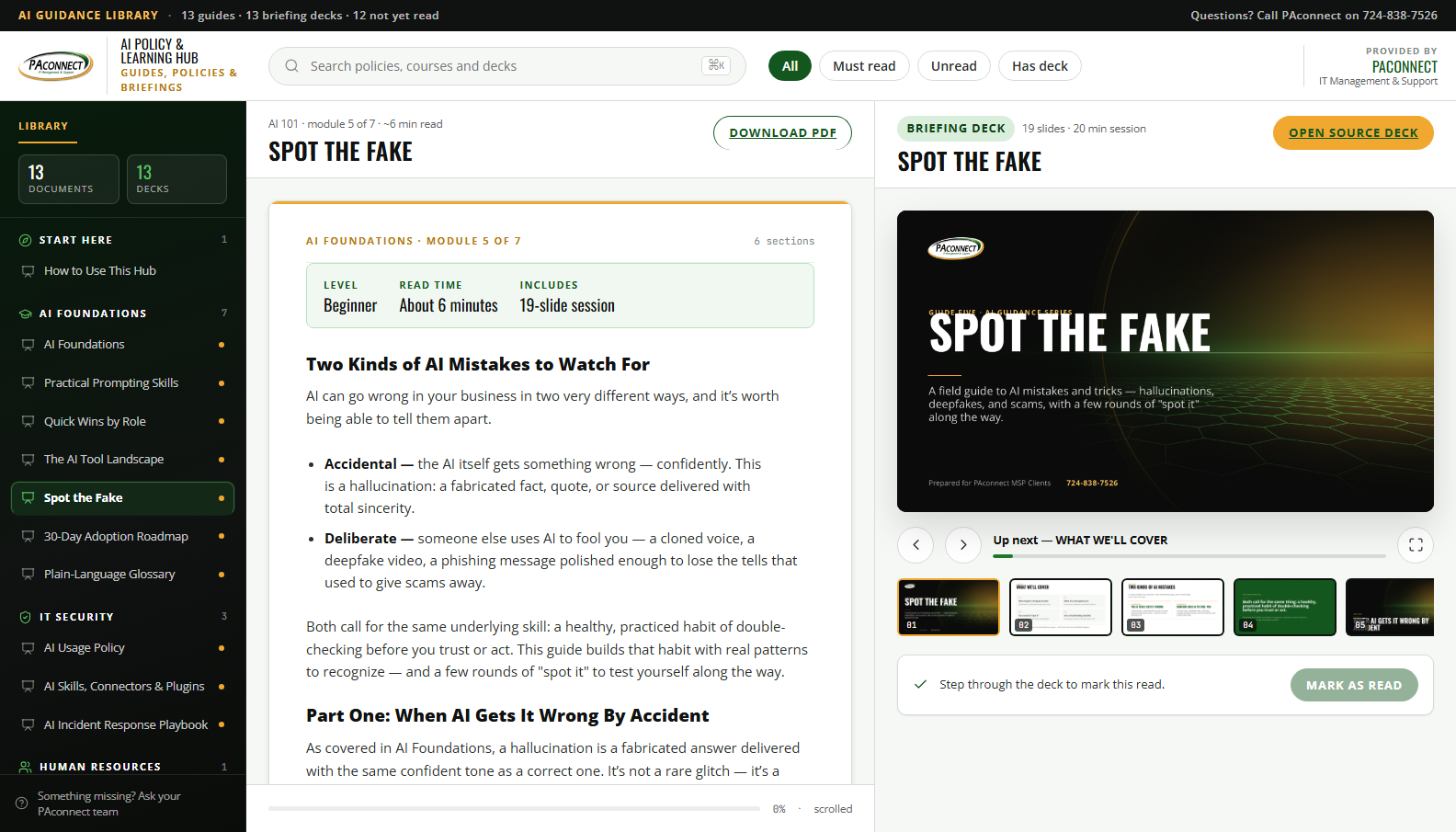
A policy tells people what not to do. It doesn't make anyone better at their job. Your team gets a working library — prompting skills, quick wins for their actual role, how to spot an AI mistake before it reaches a client — plus a kickoff session to start it properly instead of emailing a link and hoping.
Seven practical modules from a plain-language orientation through a 30-day adoption roadmap, each with a briefing deck a manager can run in a staff meeting. Delivered through the AI Policy & Learning Hub, branded to your company, with a live kickoff session for your team.
Already running, whether or not you ask for it: the endpoint protection on every machine we manage uses machine-learning detection to stop malware and ransomware that signature-based tools miss. We've run AI in production on client networks for years — this page is about the AI your people are using.
Included with managed services
Most providers will send you a policy template. We hand your team the whole program.
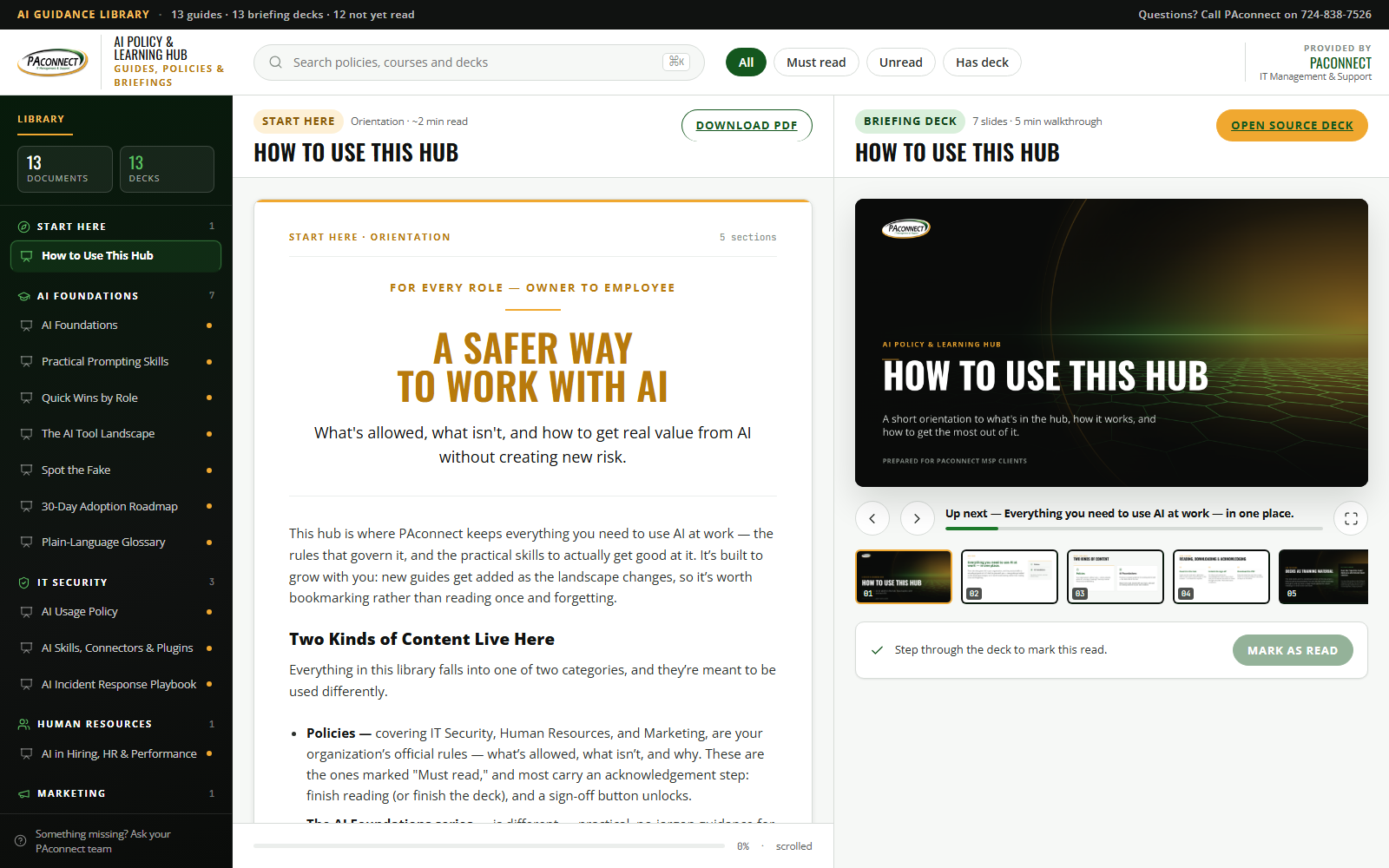
The AI Policy & Learning Hub is a live library we build and maintain — the rules that govern AI use at your company, and the practical skills to actually get good at it. It is not a PDF that dies in a shared drive. It's branded to your business, it tracks what your staff have read, and it grows as the tools change.
Your company · AI Policy & Learning Hub
Scroll the panel sideways to read it →
What's inside
Start here — a plain-language orientation for every role, owner to employee.
Seven foundation modules — AI basics, practical prompting, quick wins by role, the tool landscape, spotting AI mistakes, a 30-day adoption roadmap, and a jargon glossary.
Three IT security policies — acceptable use, connectors and plugins, and an incident response playbook.
Two department guides — AI in hiring and HR, and AI in content and marketing.
Thirteen briefing decks — 230 slides, built to be presented rather than read alone.
Two guides are free to anyone — the plain-language glossary and Spot the Fake. Take them, use them, hand them to your staff. No form, no call.
The full hub, branded to your company and maintained as the tools change, comes with a PAconnect managed services agreement.
Everyone is selling AI advice. We hand you a finished program.
Every managed services provider within an hour of here added an AI page in the last eighteen months. Read them closely and they offer the same three words: assessment, roadmap, workshop. All of it is work that starts after you sign.
✓
The program already exists
A maintained library your staff work through, written and in use before you sign.
13guides, policies and playbooks
✓
It’s ready to present
The decks to train your team with, so nobody has to build a course.
230training slides
✓
You can see who has read it
A record of what each member of staff has actually read.
✓for every person
Straight answers
The questions owners actually ask
We're not using AI yet. Is this premature?
Almost every business that tells us this turns out to be using it — just not officially. Individual staff sign up with a work email, use a free tier on their own initiative, and never mention it because nobody told them to. The review covers both cases: what's already happening, and what to put in place before you roll anything out on purpose.
Does this replace our current cyber security coverage?
No — it extends it. Your existing security stack, compliance work and risk assessments are what this is built on. AI governance is an addition to that coverage, not a separate product with its own contract. That's the whole reason it sits inside the managed services relationship rather than beside it.
What does the readiness review cost?
Nothing extra. It's part of your managed services agreement, the same as your yearly risk assessment. We'd rather find out what's exposed on your network early than sell you a discovery engagement to tell you about it.
Do we have to use Microsoft Copilot?
No. Copilot comes up in nearly every conversation because a version of it already sits inside Microsoft 365, and the fuller version is an added license, which we can supply. Either way, the honest answer to "is it safe to turn on" depends on what your file permissions would let it read. We'll help you govern and secure whatever your team is using or considering — the policy and the training apply regardless of which tool you land on.
Our data isn't clean and our permissions are a mess. Do we need to fix that first?
That's the normal starting point, not a prerequisite. It's also exactly what the exposure review is for — an AI tool connected to your files can reach whatever the person using it can reach, and over the years most people collect access they no longer need, from old roles, old projects and shared folders nobody tidied. So messy permissions are the single most common reason a rollout has to wait. We'd rather find it than have Copilot find it for you.
How much of our staff's time does the training take?
Each foundation module is a five- to ten-minute read, and each has a briefing deck a manager can run in a normal staff meeting. The 30-day roadmap is built to be taken one step per week rather than as a day off the floor. It's designed for a business that can't stop working to attend a course.
Final step
Find out what your AI tools can already see.
We don't open with a pitch or a licensing quote. We start with a conversation about how your people are already working, what data sits where, and what you're actually trying to get faster at.
Serving businesses across Southwestern Pennsylvania since 1981.